
Rapid rotators
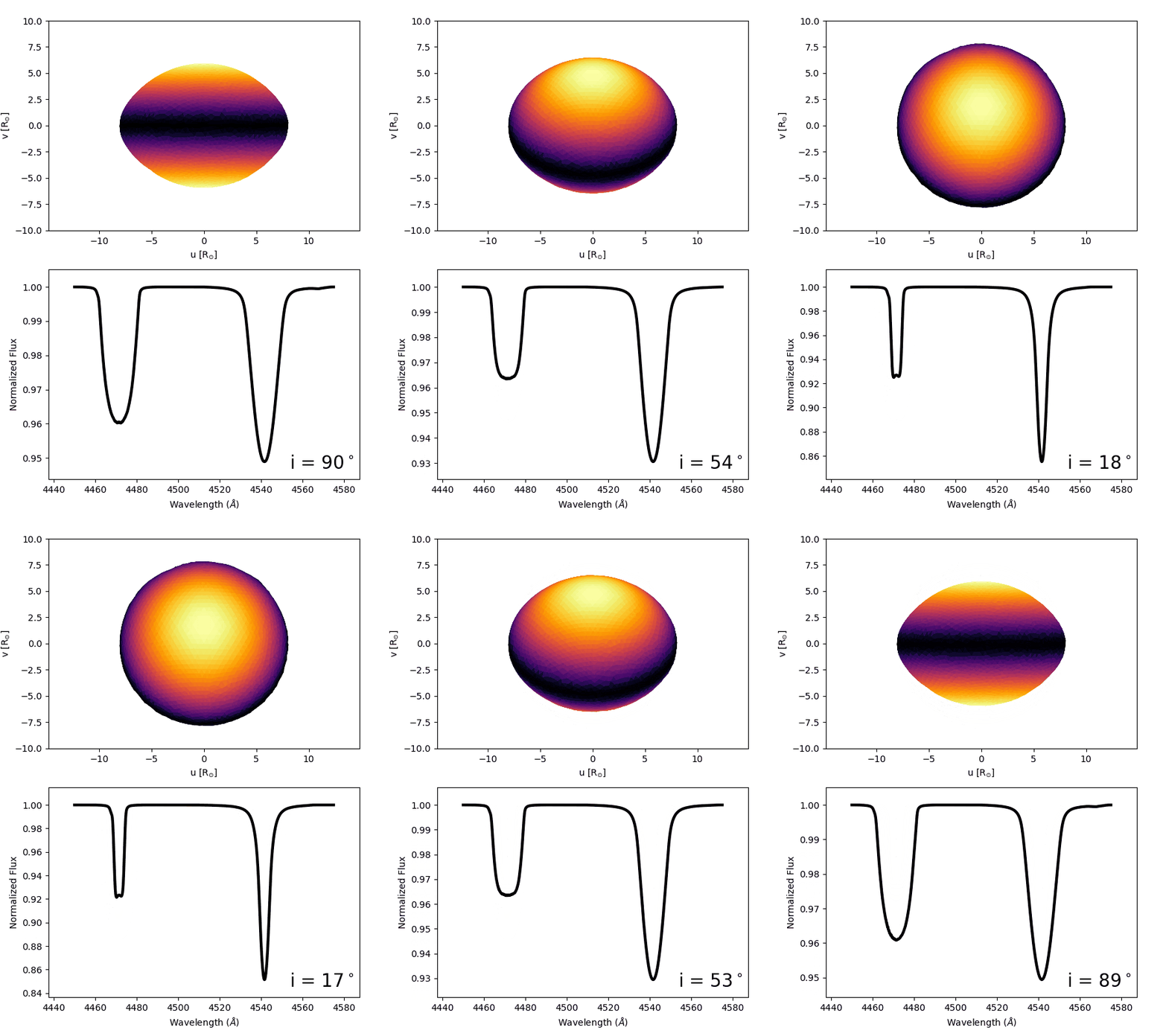
Roche geometry and gravity darkening for single stars, with rotational broadening computed from the surface itself.
Spectroscopic PAtch Model for Massive Stars: spectral synthesis for stars that are not spheres.
Rapid rotation and binary interaction distort massive stars, so their temperature and gravity change across the surface and shape the spectrum we observe. One-dimensional models cannot capture this. SPAMMS describes the star as a 3D mesh of surface elements, each with its own local conditions, and adds up their light to produce the spectrum an observer would see.
SPAMMS was created by Michael Abdul-Masih (Abdul-Masih et al. 2020). I extended it with new LTE and non-LTE specific-intensity grids, so that it now covers O- to K-type stars instead of O stars only (Galán-Diéguez et al. 2026).
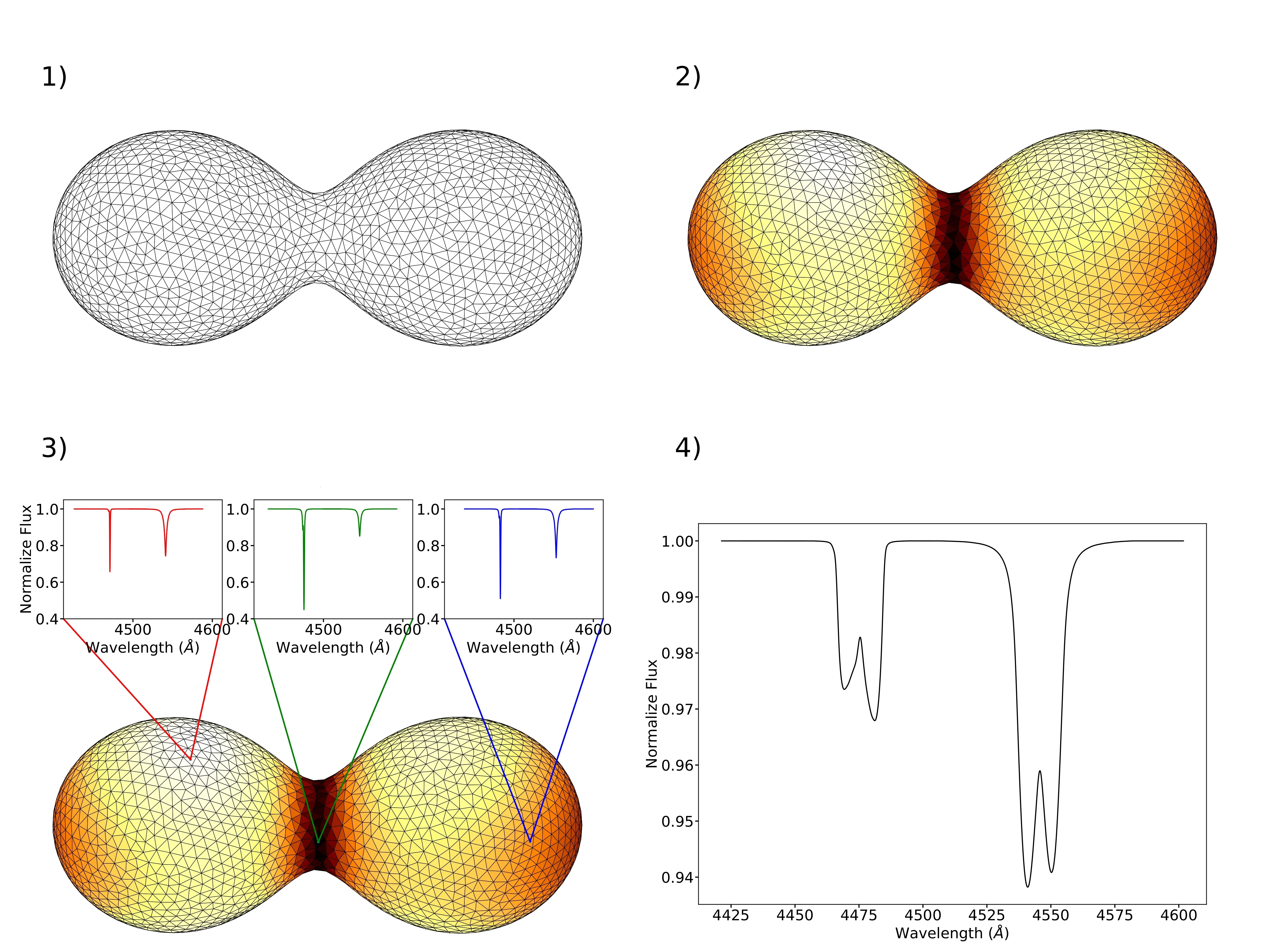
Because each element is Doppler-shifted individually, rotational broadening comes out of the geometry itself instead of being applied afterwards as a convolution. That reproduces asymmetric, inclination-dependent line shapes that a single v sin i parameter cannot.
Roche geometry and gravity darkening for single stars, with rotational broadening computed from the surface itself.
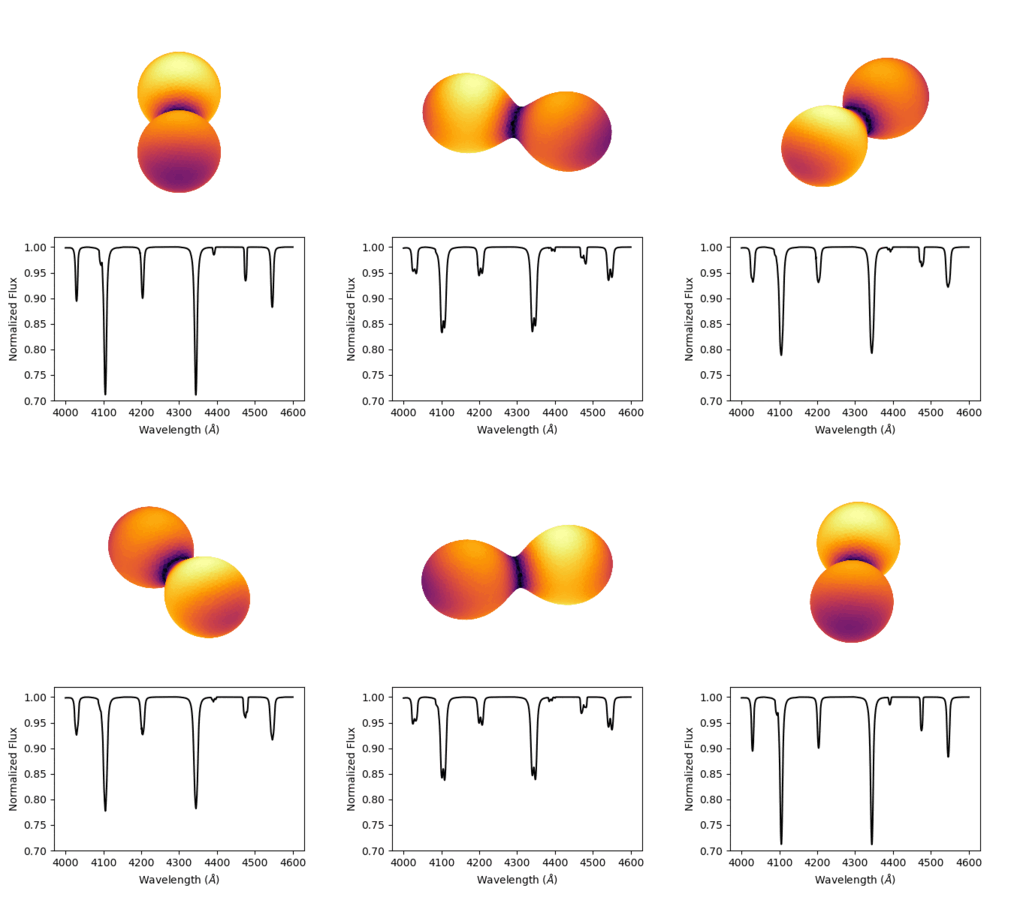
Tidal distortion and mutual irradiation of both components, phase by phase along the orbit.
A planet crossing a rotating star and the Rossiter–McLaughlin distortion of the lines.

With PRISMAS I computed specific-intensity grids from Kurucz ATLAS9 (LTE) and TLUSTY OSTAR2002/BSTAR2006 (non-LTE) atmospheres, spanning 3 500–55 000 K in Teff and 0–5 in log g, at 101 emergent angles. They are described in Galán-Diéguez et al. (2026) and available from the authors on request.
If you use SPAMMS, please cite the original paper and, if you use the Kurucz or TLUSTY grids, the 2026 paper.
Abdul-Masih et al. (2020)
@ARTICLE{2020A&A...636A..59A,
       author = {{Abdul-Masih}, Michael and {Sana}, Hugues and {Conroy}, Kyle E. and {Sundqvist}, Jon and {Pr{\v{s}}a}, Andrej and {Kochoska}, Angela and {Puls}, Joachim},
        title = "{Spectroscopic patch model for massive stars using PHOEBE II and FASTWIND}",
      journal = {\aap},
         year = 2020,
       volume = {636},
          eid = {A59},
        pages = {A59},
          doi = {10.1051/0004-6361/201937341},
archivePrefix = {arXiv},
       eprint = {2003.09008},
 primaryClass = {astro-ph.SR},
       adsurl = {https://ui.adsabs.harvard.edu/abs/2020A&A...636A..59A}
}Galán-Diéguez et al. (2026)
@ARTICLE{2026arXiv260915331G,
       author = {{Gal{\'a}n-Di{\'e}guez}, D. and {Abdul-Masih}, M. and {Allende Prieto}, C. and {Berlanas}, S.~R. and {Herrero}, A. and {Sana}, H.},
        title = "{SPAMMS: 3D spectroscopic modelling of stellar surfaces. II. Implementation of Kurucz and TLUSTY model atmospheres}",
      journal = {arXiv e-prints},
     keywords = {Solar and Stellar Astrophysics, Earth and Planetary Astrophysics},
         year = 2026,
        month = sep,
          eid = {arXiv:2609.15331},
        pages = {arXiv:2609.15331},
archivePrefix = {arXiv},
       eprint = {2609.15331},
 primaryClass = {astro-ph.SR},
       adsurl = {https://ui.adsabs.harvard.edu/abs/2026arXiv260915331G},
      adsnote = {Provided by the SAO/NASA Astrophysics Data System}
}