
Single stars and binaries
Rotating single stars are modelled with PANORAMA, and detached, semi-detached or contact binaries with PHOEBE 2, all within the same framework.
Spectroscopic PAtch Model for Massive Stars:
spectral synthesis for stars that are not spheres.
Massive stars shape the mechanical and chemical evolution of galaxies, and many of them are far from spherical. Rapid rotation flattens them at the equator, and in close binaries tides stretch both stars and can even make them share a common envelope. These distortions change the surface gravity and temperature from one point of the surface to another, and with them the spectrum we observe.
Yet the tools used to analyse these spectra are almost always one-dimensional: they treat the star as a sphere with a single temperature and gravity, and add rotation afterwards by convolving the lines with a broadening kernel.
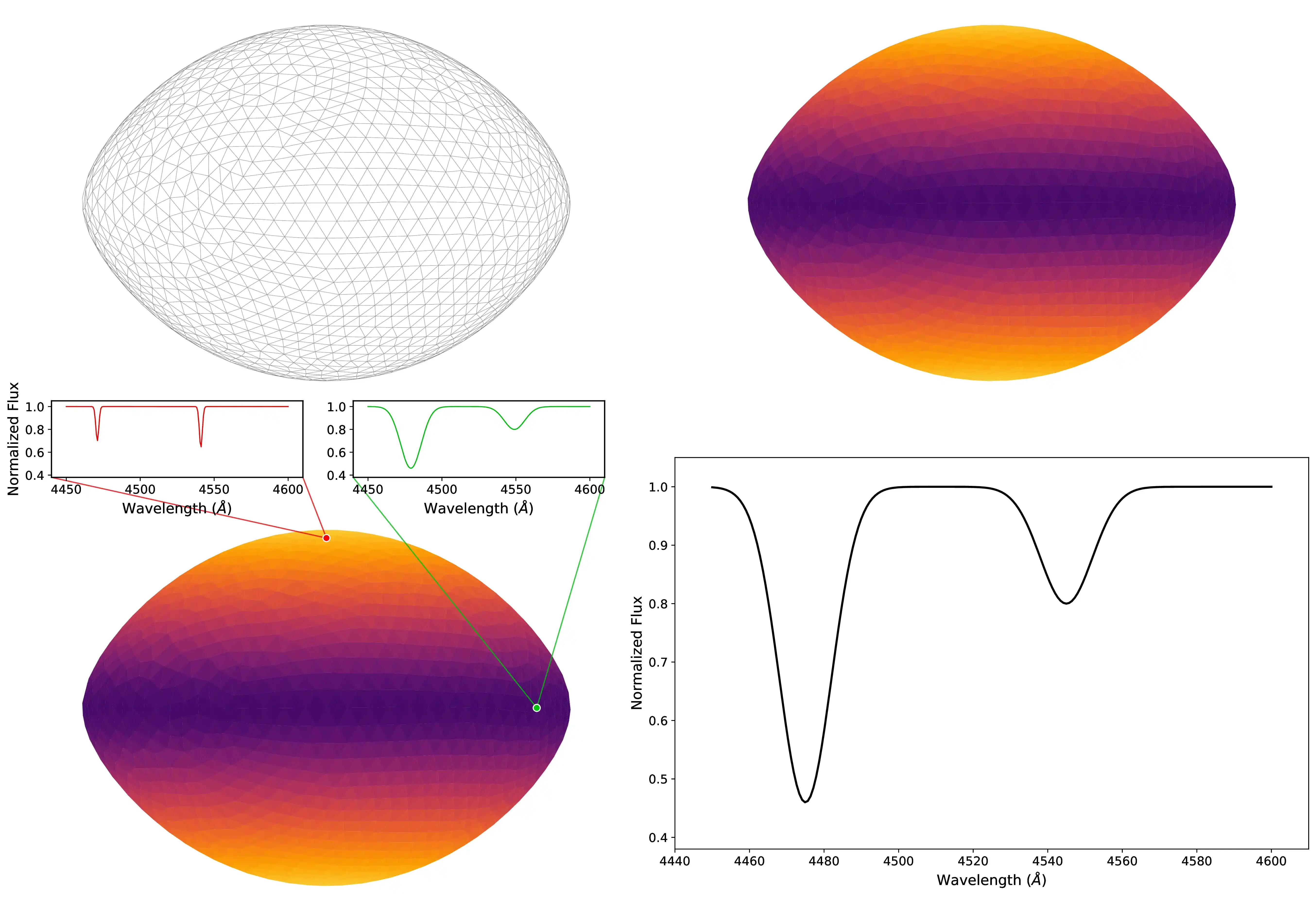
SPAMMS (Spectroscopic PAtch Model for Massive Stars) takes the three-dimensional geometry of the system into account. It builds the distorted surface as a mesh of small triangles, with PANORAMA (for rotating single stars) and with the PHOEBE 2 code (for binaries), and combines it with model atmospheres that give the emergent line profile of each triangle — according to its own temperature, gravity and viewing angle. Integrating the light of the visible surface, with the radial velocity of every element, returns the spectrum an observer would see at a given orbital phase and orientation.
Because each element is Doppler-shifted individually, rotational broadening comes out of the geometry itself instead of being applied afterwards as a convolution. That reproduces asymmetric, inclination-dependent line shapes that a single v sin i parameter cannot.
From a 3D surface mesh to the line profile an observer would see.
What sets SPAMMS apart: from physical modelling to practical spectral analysis.
Rotating single stars are modelled with PANORAMA, and detached, semi-detached or contact binaries with PHOEBE 2, all within the same framework.
Angle-dependent specific intensities make limb darkening intrinsic, line by line, instead of relying on a parametric law.
LTE and non-LTE grids from 3 500 to 55 000 K and log g 0–5, at 101 emergent angles, computed with PRISMAS.
Series of models over parameter ranges run in parallel and can be compared directly with observed spectra.
With PANORAMA, SPAMMS and interferometry, observables are derived from the same stellar surface, enabling a complete analysis of the stellar properties of rotating stars.
Bayesian parameter estimation with full posteriors, being implemented in collaboration with Newcastle University.
Contact binaries, rapid rotators and planetary transits with the same machinery.
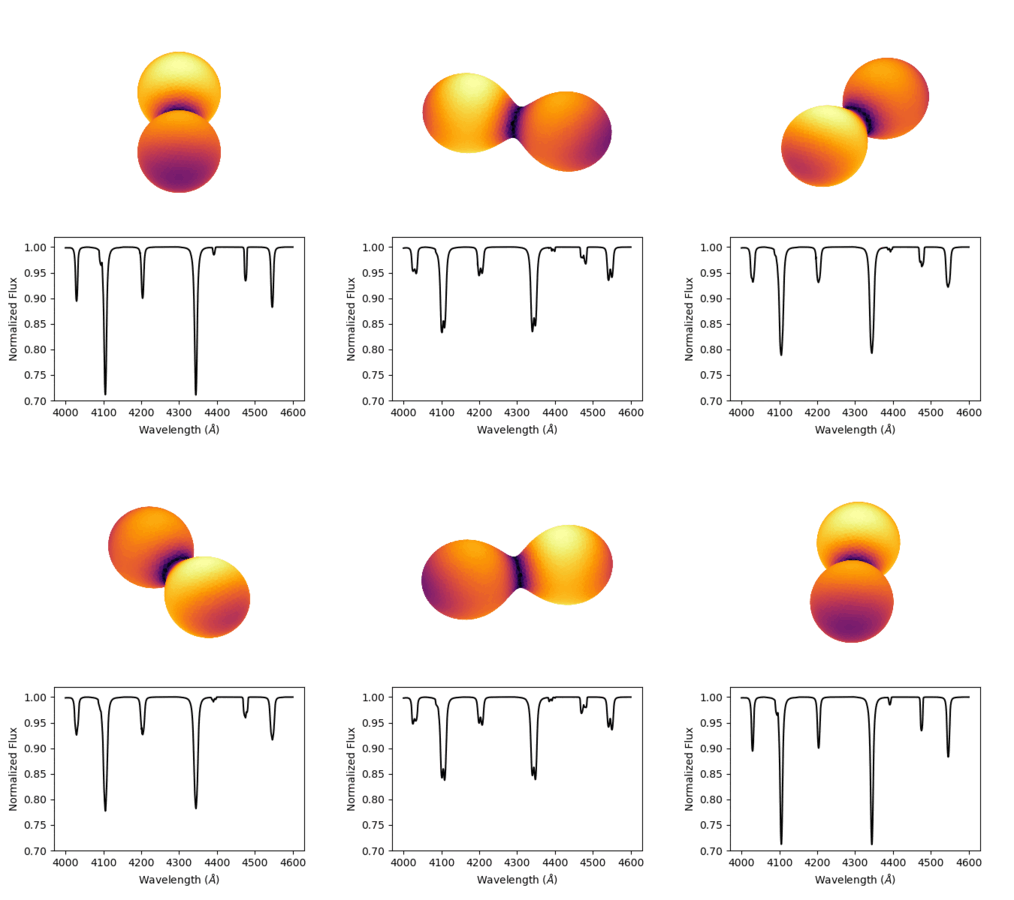
Surface temperature, with contrasts above 10 000 K, and the He I and He II lines through the orbit. Both stars and the overcontact surface are modelled together.
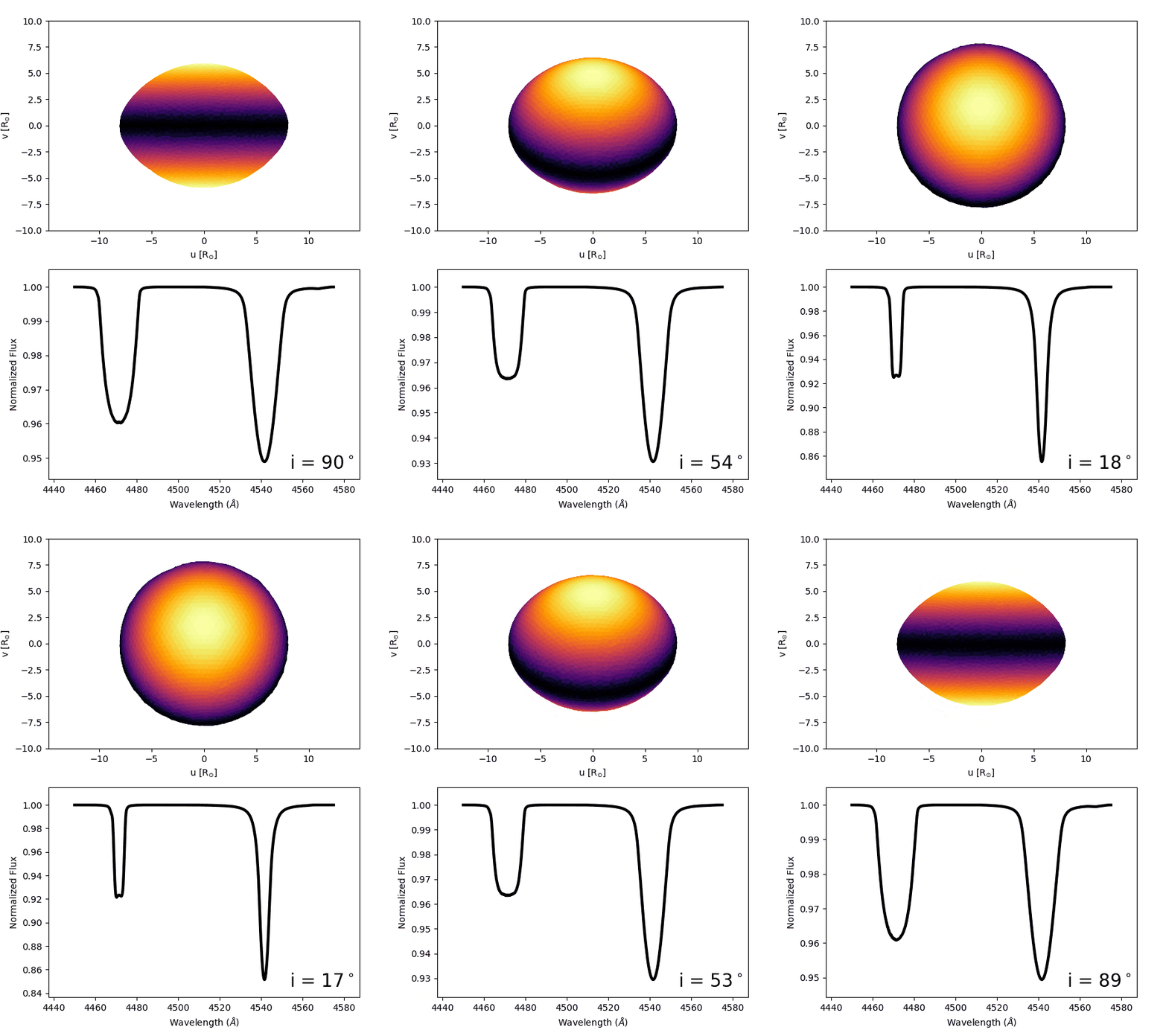
Hot poles and a cool equator. Seen pole-on, He II strengthens and He I weakens, so a spherical fit would overestimate the temperature.

A planet crossing a rotating star blocks part of its surface, and the missing light travels through the line profile during the transit.